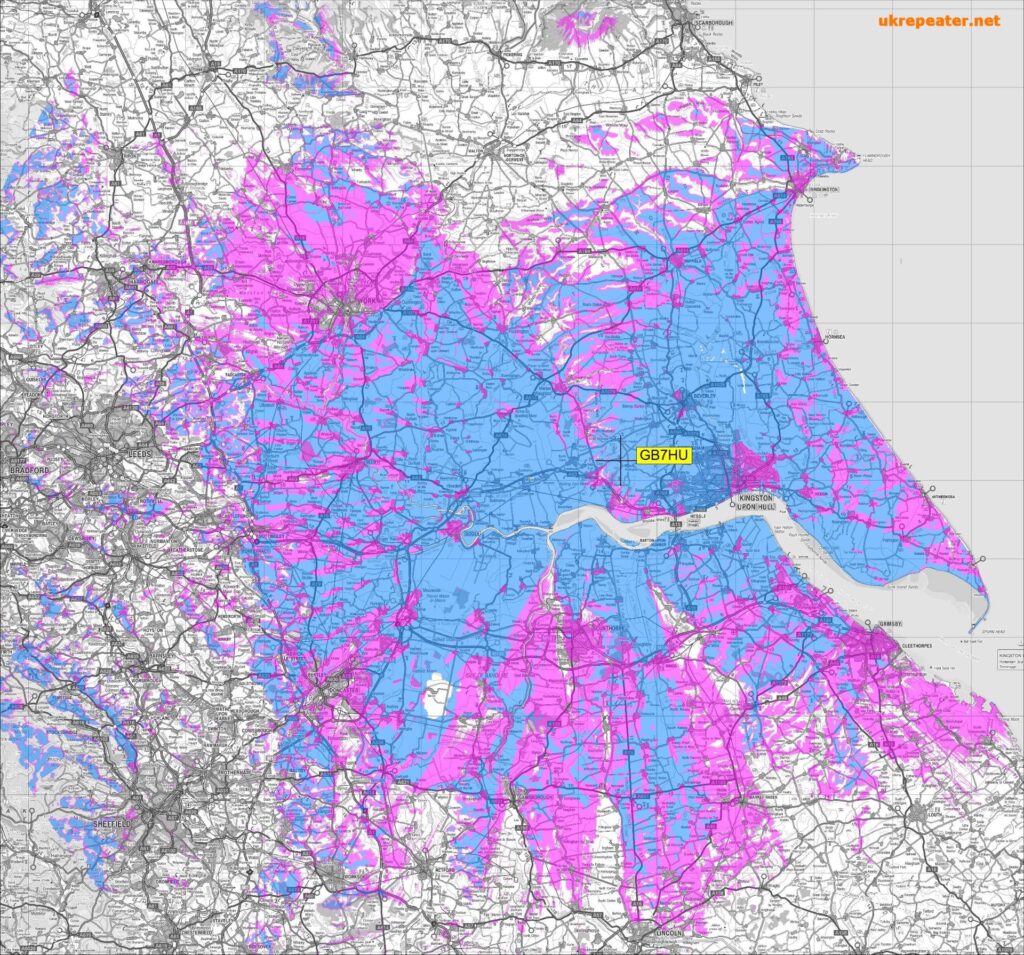
Coverage
Quick details
| Channel | DVU39 |
| Output / Input frequencies | 439.4875MHz / 430.4875MHz |
| CTCSS Tone | Not used |
| Modes | 12.5kHz spacing D-Star |
| Location | Cave Wold Radio Station Riplingham, E. Yorkshire |
| Locator | IO93RS37 |
| Power | 25W E.R.P. |
| Antenna | Procom Co-linear @ 22m AGL, site 155m ASL |
| Equipment | Icom ID-RP4000V & ID-RP2C |
| Gateway Software | Pi-Star on Raspberry Pi2 |
| Status | Permanently Off-air |
News
GB3NY lost its site because the new land owner decided that he did not want a PMR antenna mast on the top of his grain store roof because the cost of insurance was prohibitive. As GB3NY gets much more use than GB7HU it was decided to retire HU so that its antenna could be redeployed for NY. Additionally, low usage of HU did not justify its running costs and the transmitter appears to have developed a low power output fault. The transmitter frequencies used by NY and HU make it impractical to run both repeaters at the same site. The EYRG is committed to provide a D-Star service which is likely to appear on NY alongside Fusion and DMR.
Details
The repeater replaced the 70cm GB3HU repeater which was little used at the time. It was established with the help of a grant from the National Lotteries’ Community Fund. The grant was requested to promote the use of digital radio communications in emergencies to be operated by the Repeater Group’s Emergency Communication division. The grant also allowed the Group to acquire equipment for training sessions leading to the licence examinations. The emergency division of the Repeater Group later merged with other emergency comms groups and became Humber Raynet.
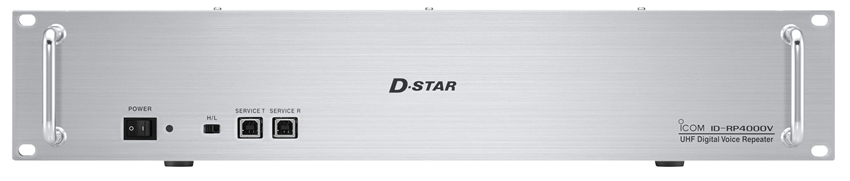
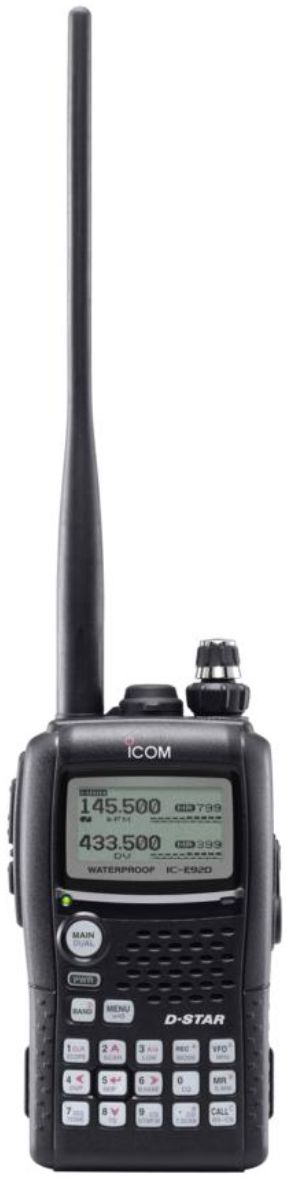
The grant provided funds to purchase the Icom repeater hardware, a Procomm co-linear antenna, a Linux PC, two power supplies, two Icom-2820E dual band transceivers and five dual band IC-92E hand held transceivers, projector and screen. The equipment remains the property of the Repeater Group, but is used by Humber Raynet, who continue to have a close relationship with the Repeater Group.
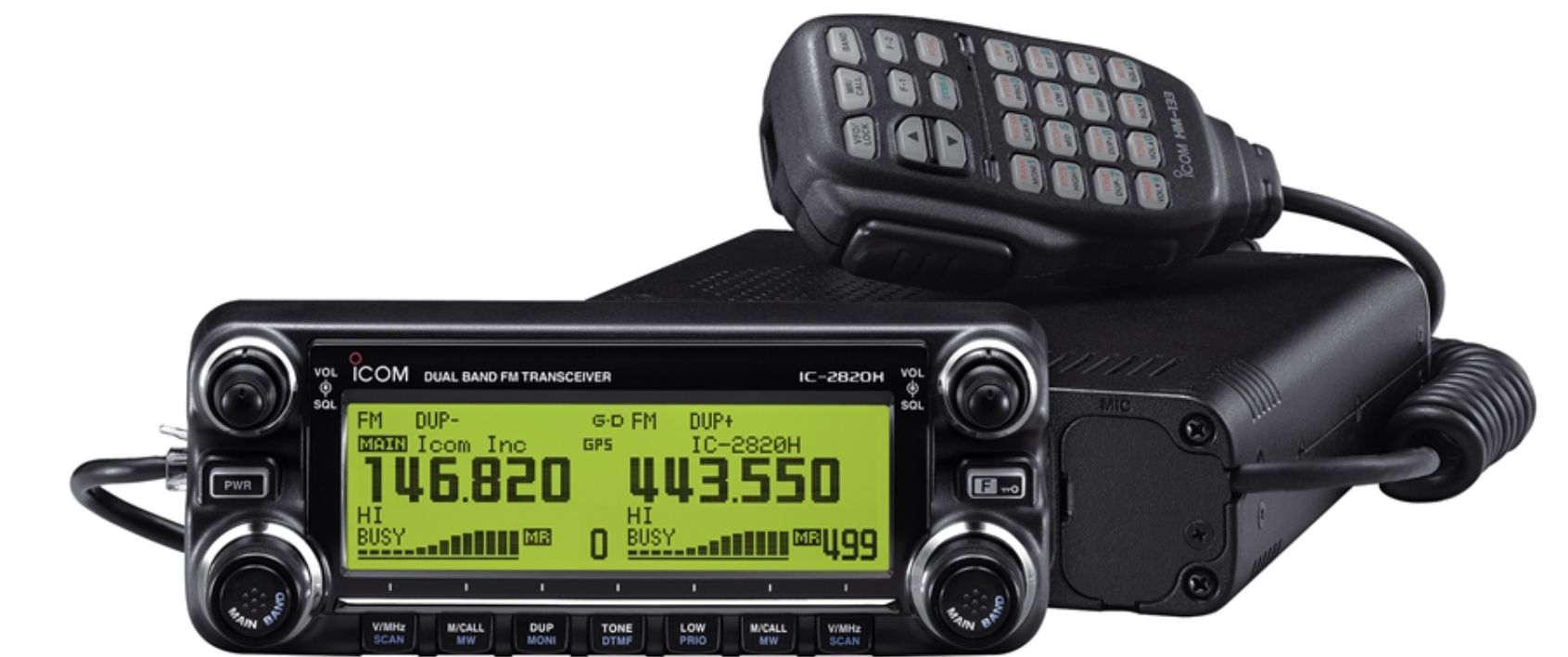
Initially, the Icom G2 software was run on an old distribution of Centros OS, that worked well but it was not being updated. The OS was replaced with Windows and a Windows version of the G4KLX software was used for many years. This too became a eventually became a victim of a lack of ongoing support and an alternative was sought. With the need to reduce power consumption in mind, the Windows PC was replaced by a Raspberry Pi 2 SBC running a Pi-Star image. This works well, but doesn’t cope well with the power being switched off between 10pm and 1pm; it often locks up. A solution is being sought.